NEW: Quandri introduces AI Workflows for P&C Operations → Learn More
What end-to-end renewal automation actually looks like inside a brokerage, from policy download to client communication.

Insurance renewal automation is the process of running the full renewal lifecycle, from policy download and year-over-year comparison through requoting and personalized client communication, without requiring account managers to manually open, check, or action each file. For most agencies, renewals are the largest operational cost center and the most direct lever on retention. Automating them is what changes the economics of the work.
Three hundred renewals due in the next 60 days. In most agencies, that means the next few weeks look the same way they always have: the account manager pulls policies one by one, checks what changed, digs into underwriting data, decides what needs attention, builds quotes when the rate moves too much, and drafts client emails that go out late, if they go out at all.
The work isn't hard. It's just relentless, and at volume, relentless wins.
The agencies changing how this works aren't doing it by hiring faster. They've restructured the renewal lifecycle. From policy download to client communication, the majority of renewal work runs without manual intervention, and account managers spend their time on the policies that actually need their judgment.
In this post:
When a policy downloads from the carrier into the agency management system (AMS), Quandri automatically starts analyzing. No drag and drop, no one has to open the policy, queue it, or remember to check it. The work runs overnight, before your team gets into the office.
Quandri reads the policy data and produces a full year-over-year comparison: premium changes, coverage changes, missing coverages, and discounts that appeared or dropped. Every relevant data point surfaces in a single view before the account manager touches the file.
Not every renewal needs the same response, and the workflow accounts for that.
If a premium increase clears a configured threshold, requoting triggers automatically. Quandri extracts underwriting data from the AMS, runs the market, and returns the top competitive quotes directly inside the AMS. If no competitive alternative exists, the agent is notified so they can skip the manual check. Policies with coverage gaps, missing discounts, or flagged risk changes route to agent review with talking points already generated. Policies that are straightforward proceed toward client communication.
Account manager judgment applies where it's needed. The system executes the rest.
Every book has the same patterns. A rate that moved more than the risk profile justifies. A coverage that was there last year and isn't this year. A client who's gone quiet for two renewals in a row. A discount that quietly disappeared. Agents know these situations exist in their book. The problem is finding them before the client does.
Here's what systematic flagging looks like in practice.
A home policy comes in at 18% higher than prior term with no changes to the risk profile. Requoting triggers automatically. Competitive options come back, and a client email gets drafted with the alternatives and a recommendation already built in. The agent reviews and sends.
None of these are unusual. They show up across every personal lines book, at a frequency most agencies can't track manually. Consistently catching them on every policy is what systematic automation makes possible.

Once review and any required requoting are complete, Quandri generates a personalized client email using everything the engine surfaced: the premium change, what drove it, coverage differences, and where applicable, alternative quote options.
The email sends from the agency's own domain and references the client's specific policy. The account manager reviews, edits if needed, and sends with a single click. The email attaches automatically to the AMS.
Most agencies reach 20-30% of renewing clients proactively. The rest get generic outreach or nothing at all. When communication runs at scale, every renewing client gets a timely, personalized touchpoint before they have a reason to shop around.
Account managers don't open 300 files and work through them one by one. They open a prioritized queue: which policies need attention, why each one was flagged, what's already been handled. The review work, the requoting, the routine client communication is done before they sit down. What remains is the work that actually requires their expertise.
The client whose premium jumped significantly and who will call the moment they open the renewal letter. The coverage question where the right answer depends on something you know about that household that isn't captured anywhere in the AMS. The long-term client who's been with the agency for 12 years and whose situation deserves a real conversation, not an automated email.
Most account managers aren't spending their time there when renewals are still manual, because the volume won't allow it. Agencies running manual renewal workflows spend the majority of their capacity on execution, not advising, and that's a structural problem additional headcount doesn't fix.
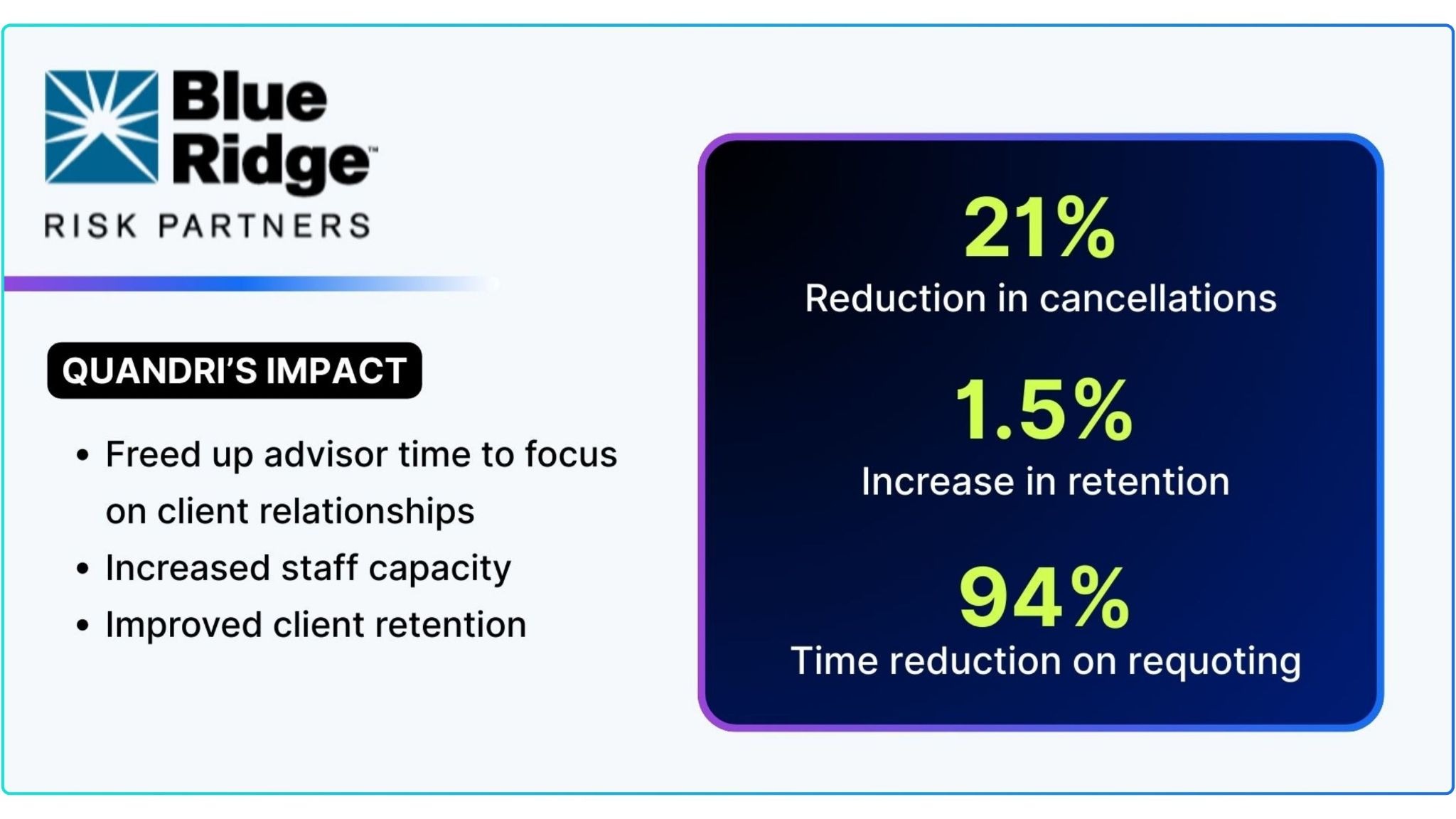
Blue Ridge Risk Partners, a top 75 U.S. agency, ran into this directly. Manual requotes consumed up to 90 minutes each. Their team was buried in data entry rather than in client conversations, and renewal opportunities were slipping through the cracks. After implementing Quandri:
As Tia Viglianco, Chief Innovation Officer at Blue Ridge Risk Partners, put it: "Quandri helps us catch up, so our team can focus on being educators and professionals."
With 16,000 hours returned to their advisors annually, the work didn't get smaller. It changed what they focused on.
The capacity benchmark for agency operations has held at roughly 1,200 policies per account manager for a decade. It hasn't moved because the structure of the work hasn't changed, and agencies that keep running renewals manually will keep hitting that ceiling.
Automating the renewal lifecycle is what breaks through it. The agencies doing this are operating at a standard that's becoming the baseline, and the gap between them and everyone else is widening every renewal cycle.
Ready to see what this looks like for your book? Book a demo and we'll walk through your renewal workflows together.
Get the latest on AI for insurance and industry trends.
Sign up now.